
On-device AI is designed to detect risks during unmanned hours right on site — no cloud round-trip — and to let only pseudonymized safety logs leave the device (upstream transmission is disabled by default today, and there is no live-gym transmission record yet).
Every inference completes on the edge device inside the venue. There is no continuous recording — decisions are made on site, and the device is designed to let only pseudonymized safety signals leave it (upstream transmission is disabled by default today). (Detection inference latency is from a single-run bench on our own hardware and varies by environment.)
On-site devices detect candidate falls, equipment accidents, and anomalies from skeletal keypoints estimated from the camera image (detection and false-alarm rates to be measured on our own hardware). Ordinary frames are discarded right after on-device inference rather than continuously recorded; only short, face-blurred clips of risk events are kept on the device.
Pose-signature AI instantly classifies and clusters risk from grade A (critical) to F (normal).
Built to deliver risk events to owner and HQ consoles, with a four-stage response kanban for action history (console upstream is disabled by default today; no live-gym record yet).
Sample UI data for product demonstration — not real stores, members, or incidents.
A product demo recreating the actual Fit-Edge control console UI · data is simulated

Fitness facility monitoring method and device using video recognition and AI
Patent No. 10-2786321 · Registered Mar 20, 2025
Granted scope: detection and notification of risks in sports facilities using video recognition and AI. Other functions are outside the granted scope.
The same accident, two very different response timelines.
Compare what happens with and without Fit-Edge.
During unstaffed hours, a member collapses next to a machine.
3:00:00 AMOn-device edge AI immediately evaluates a fall-candidate pattern (inference latency measured at under 0.1s in-house; varies by environment).
3:00:00.1 AMA risk alert is sent to the owner's and managers' phones, and their reply is recorded as an acknowledgement (currently supported channel: messenger push).
3:00:03 AMThe owner verifies the scene remotely from the console; on-site warning indicators (LED and display) draw attention.
3:00:45 AMIf a risk state persists, the on-site manager is alerted immediately and can review remotely and call emergency services if needed.
3:04:00 AMThe full detection-to-response trail is kept as a pseudonymized log. Incident record for review
Right afterDuring unstaffed hours, no one notices.
3:00:00 AMCCTV keeps recording, but no alert reaches anyone.
…3 hours of golden time lost — the first response comes 3 hours late.
6:00:00 AMThe timings above are illustrative scenario examples; actual response times vary with site conditions and settings.
Fit-Edge is a detection, alert, and record-keeping tool that assists safety; it does not guarantee detection or rescue of every incident and does not replace a store's own safety-management responsibility. It is not a medical device and does not provide medical diagnosis or judgment.
Fit-Edge is built to feed captured risk events into the HQ admin console (console upstream is disabled by default today; no live-gym record yet) — designed so alerts, records, and response history are managed on a single screen. Below are actual admin-console screens; the data shown is a demo.
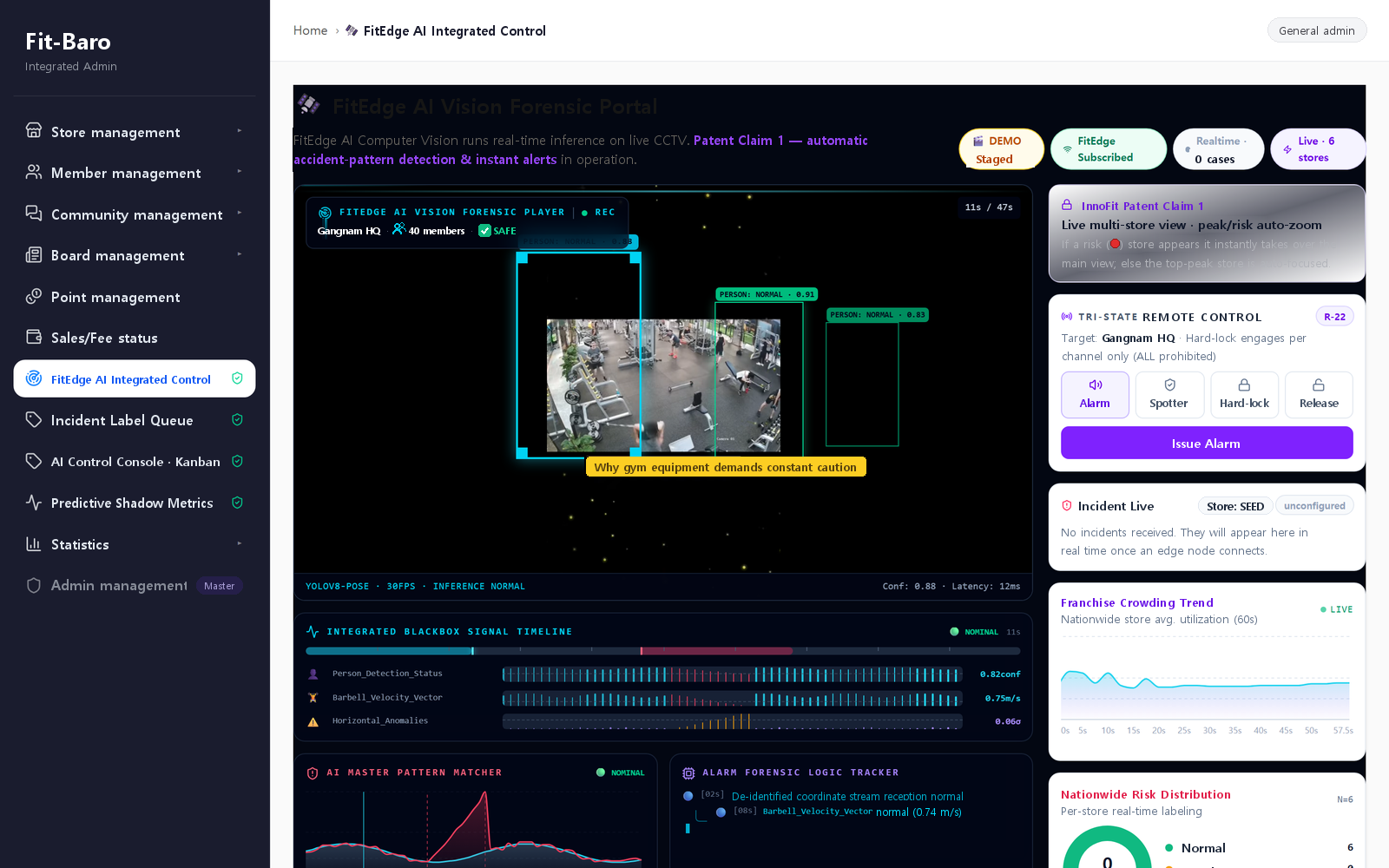
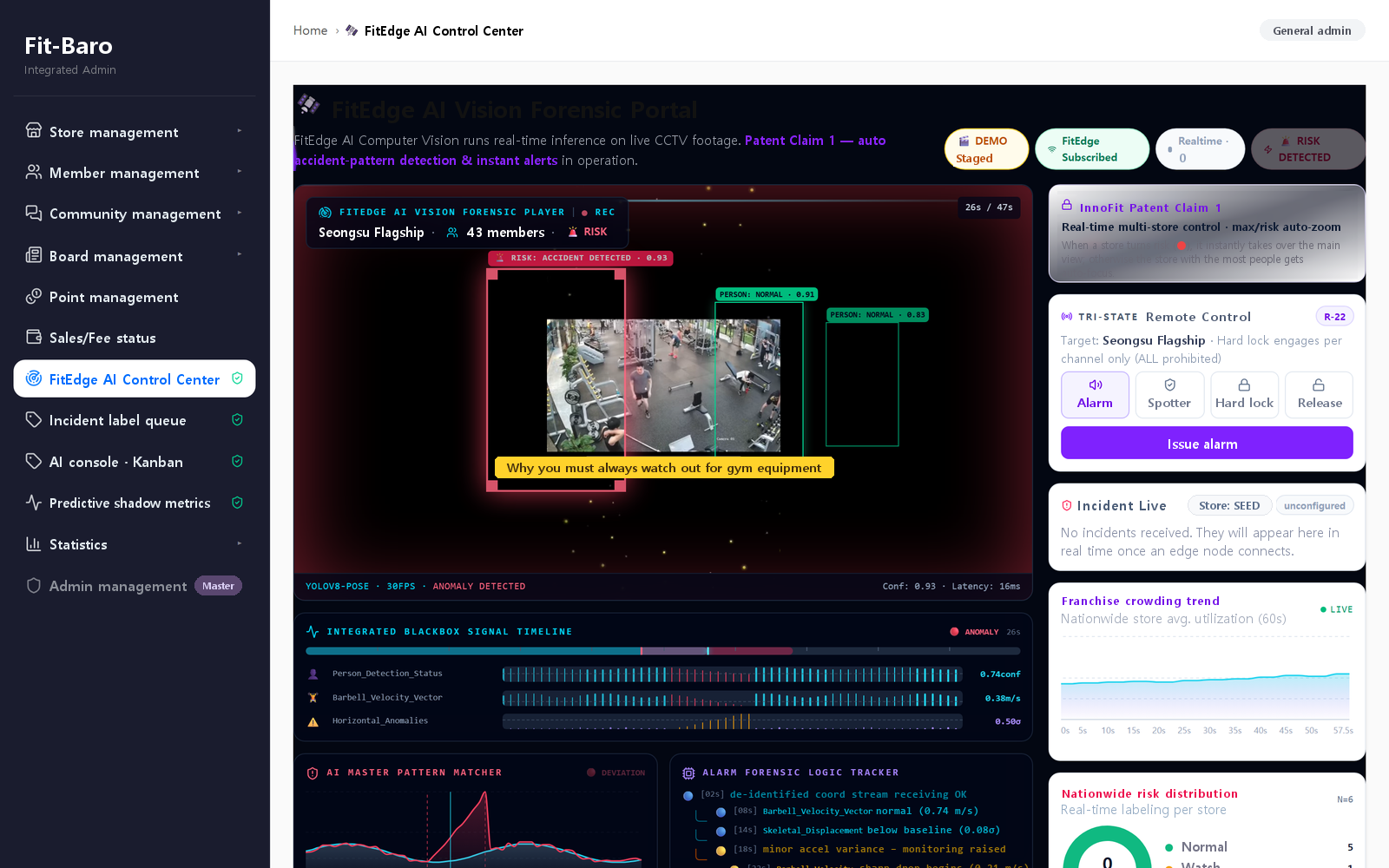
Built to log risk events in the console as pseudonymized metadata (upstream transmission is disabled by default today, so there is no live intake record yet). The screen provides store- and period-based queries around an incident.
Anomaly detected → remote check → on-site response → resolved. Every incident keeps a stage-by-stage action history.
Built to let you review detected risk events remotely from the console and keep a full response history (console upstream is disabled by default today).
What leaves the device is whitelist-enforced, pseudonymized event metadata. Live view and stored clips are reachable only from an authenticated console (configuration dependent).
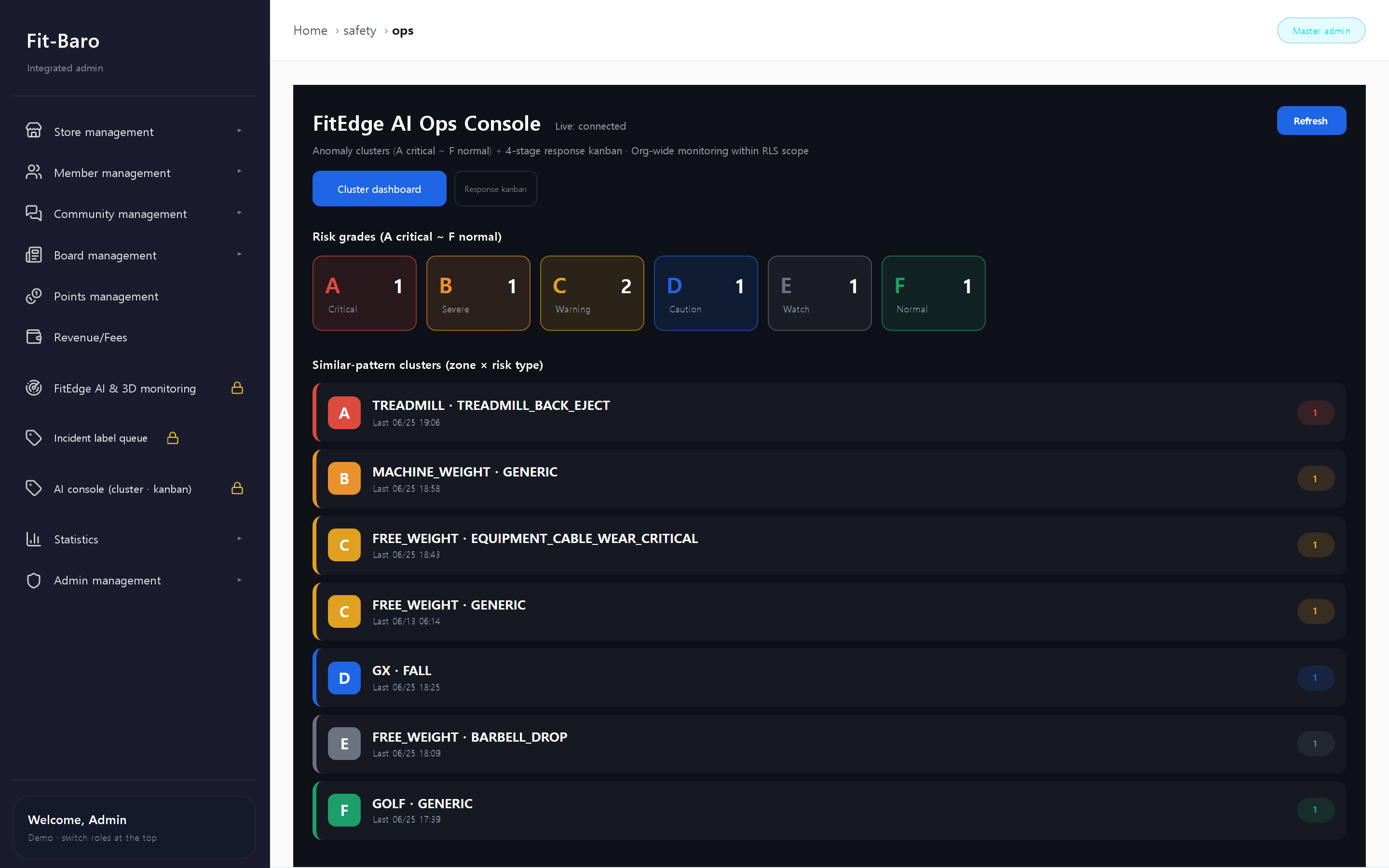
Screens show the actual admin console UI; the data shown is a staged demo.
*Detection latency is from a single-run bench on our own hardware (varies by environment). †Continuous 24-hour operation was confirmed once in a separate in-house run (no interruption, zero restarts) at a sustained throughput of about 7 frames per second. That same run's overall verdict was a fail — memory grew 8.54% against a 5% threshold — and the core-only re-measurement has not started yet. Detection (miss) and false-alarm rates have no field measurement; the figures we hold today are from synthetic scenarios. We will publish field figures together with their test conditions once measured.
Ordinary frames are discarded right after on-device inference. Only short, face-blurred clips of risk events are kept on the device. The camera doesn't "watch" — it detects.
Pseudonymous identifiers (SHA-256 with a daily-rotating salt). A layer applying differential-privacy (Laplace) noise to numeric fields of upstream payloads is implemented, but upstream transmission is disabled by default today, so there is no applied record yet (scope and parameters documented at onboarding). Legal characterization of the data is under review.
Built to grade, record, and deliver only the minimal event metadata required for monitoring (upstream transmission is disabled by default today).
From PoC to on-site deployment, we walk the validation journey with you. In Korea, unmanned operation of sports facilities requires checking applicable regulations first, including the Sports Facilities Act's instructor-staffing duty.